What This System Delivers
- Grounded answers from an owner-approved business profile and FAQ knowledge base
- Structured conversions from natural-language chats into bookings and qualified leads
- Deterministic guardrails around every action that can change business data
- Human approval before a customer booking becomes an accepted commitment
- Local-first records with a clear path from a single-business pilot to a managed deployment
Most small businesses do not need another generic chatbot. They need a reliable front desk that can answer repetitive questions, qualify a customer, collect a booking request, and hand the outcome to a human owner.
That is the idea behind the Local AI WhatsApp Assistant: a configurable application for gyms, clinics, salons, cafes, tutors, repair services, consultants, and other appointment- or lead-driven businesses.
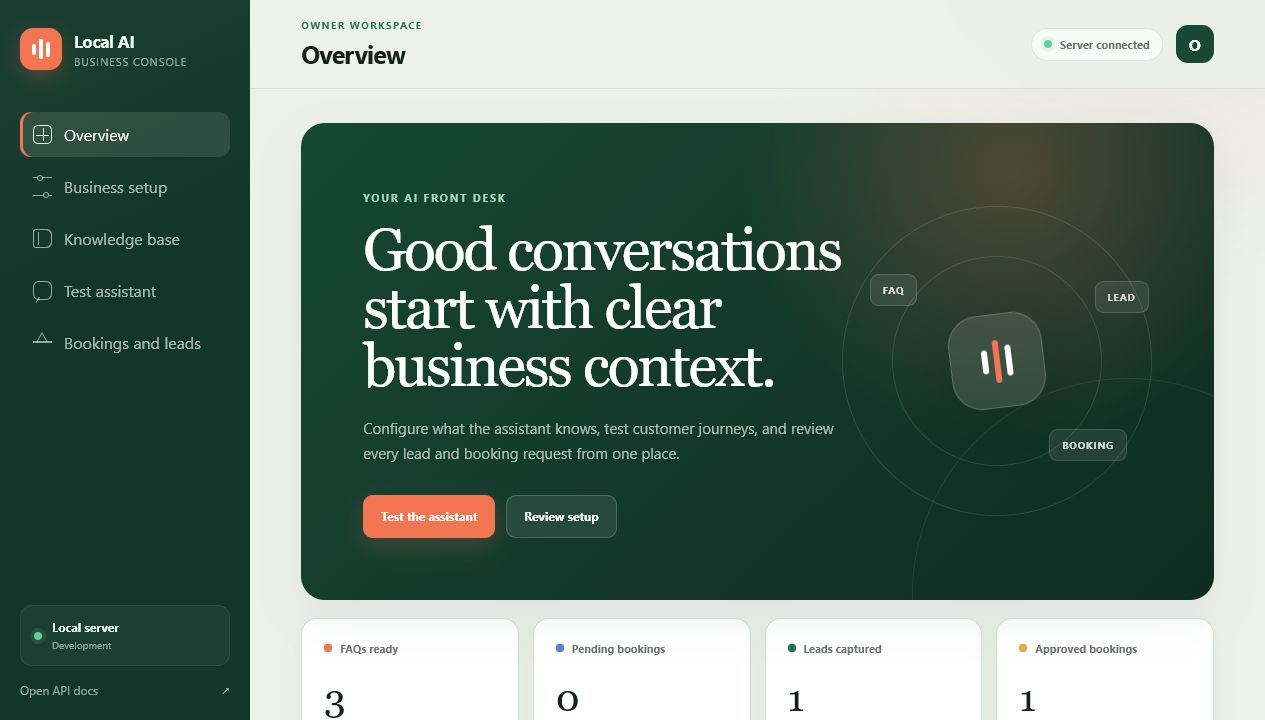
The owner dashboard turns AI conversations into a visible pipeline of FAQs, leads, and booking requests.
The Business Problem
A customer rarely experiences a business as a collection of software tools. They experience one conversation: Are you open today? How much does it cost? Can I book an assessment? Can somebody call me?
When those messages sit unanswered, the business risks losing the customer at the moment of highest intent. A conventional chatbot can reply quickly, but a fast wrong answer is not an improvement. It can invent a price, imply that a slot is confirmed, or repeat a policy that the owner has already changed.
A Controlled Workflow, Not an Autonomous Bot
pending until a human approves, cancels, or completes them. The assistant captures intent; the business keeps authority.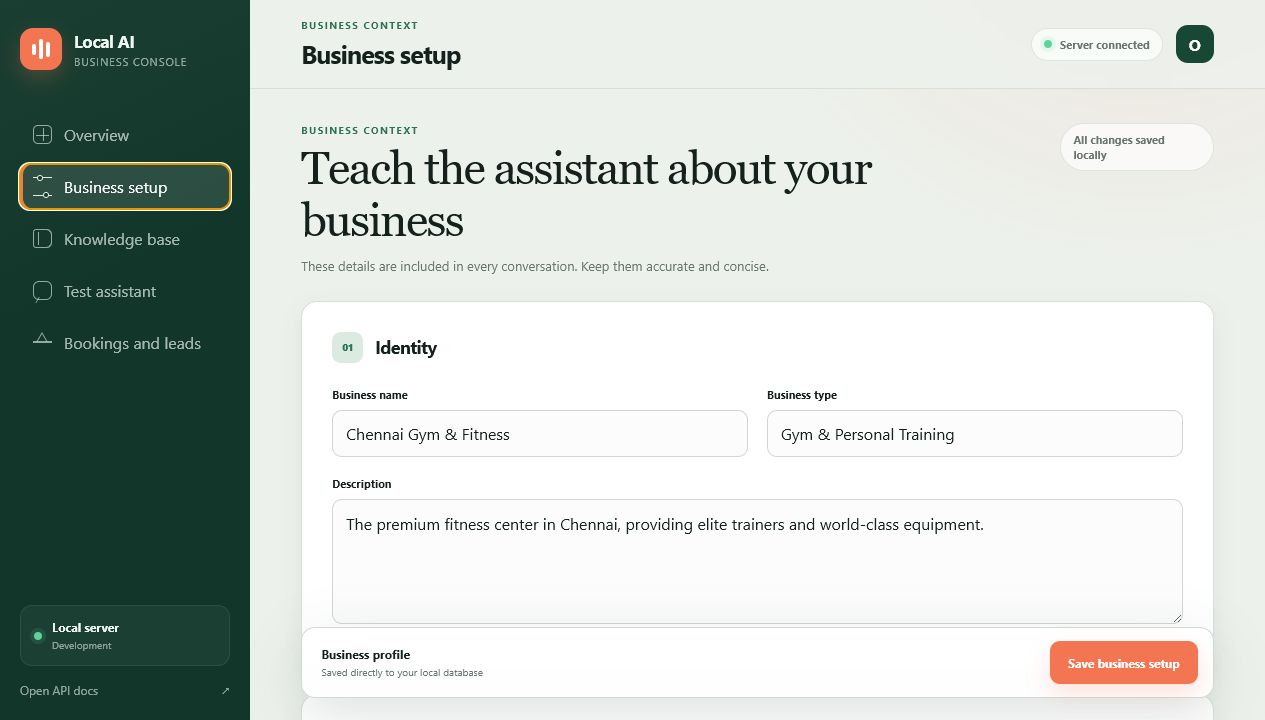
Business identity, timezone, capacity, and booking rules are configured without editing Python code.
Approved Knowledge Instead of Invented Answers
Owners can add and remove FAQ pairs from the dashboard. The prompt explicitly tells the model not to invent prices, availability, policies, guarantees, or professional advice. This does not make hallucination mathematically impossible, but it reduces risk by narrowing the source context and validating all structured actions outside the model.
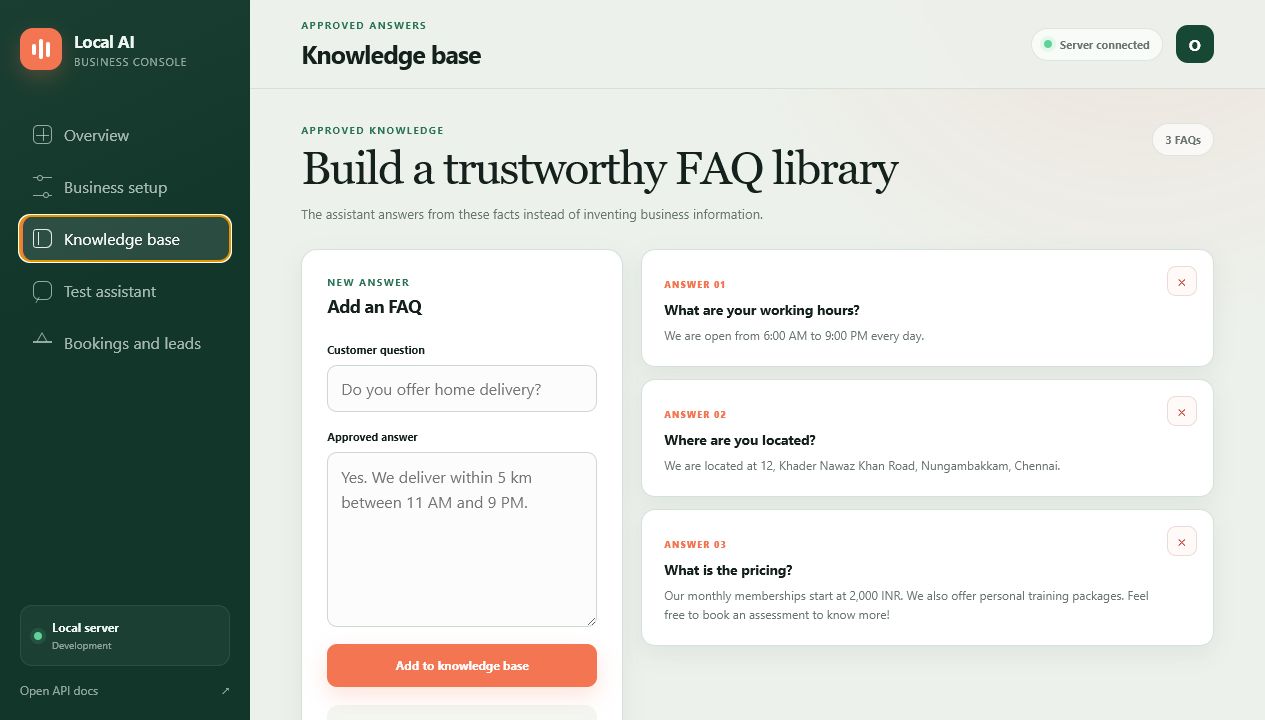
The demo knowledge base contains exact answers for working hours, location, and starting membership prices.
Test the Customer Journey Before Connecting WhatsApp
The built-in Conversation Lab uses the same knowledge, Gemini model, database, and validation path as the WhatsApp webhook. It gives an owner or implementation consultant a safe place to test factual questions, incomplete requests, bookings, callback leads, and attempts to override the assistant's instructions.
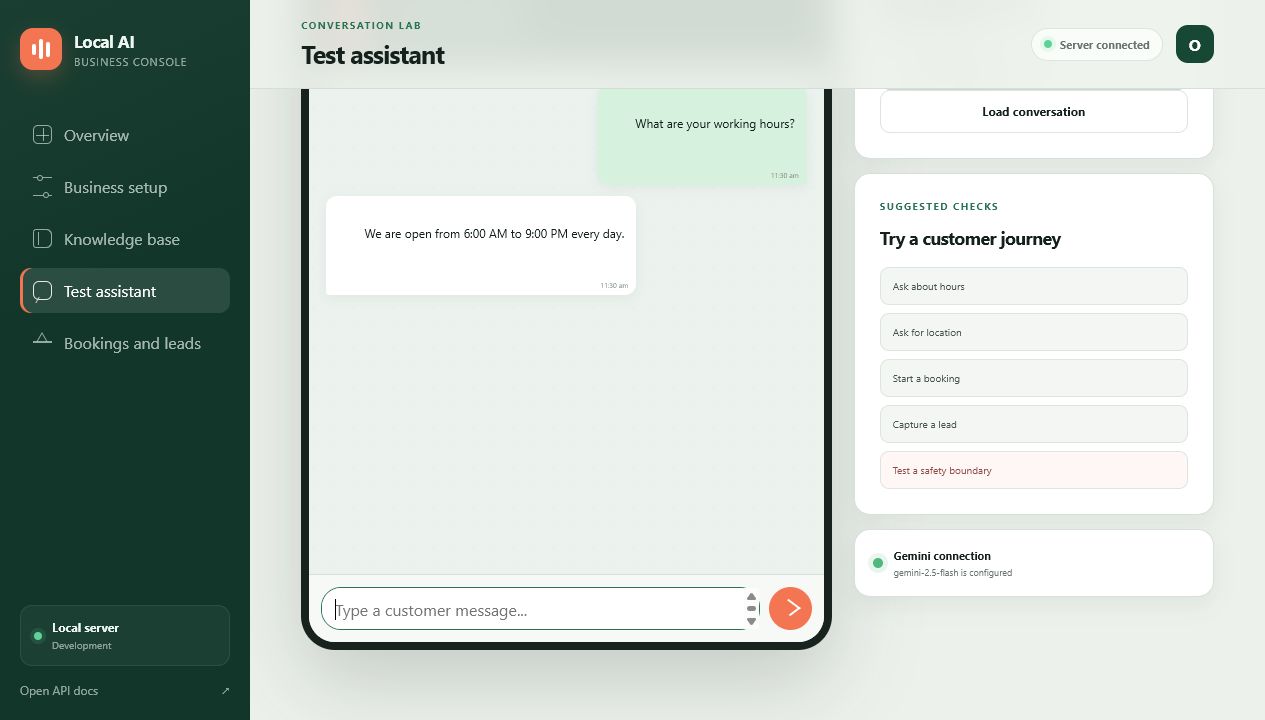
A customer asks about working hours and receives the owner-approved answer.
From Conversation to Booking and Lead
A booking stores the customer, phone number, requested service, original time wording, normalized appointment time, business timezone, status, and source message identifier. A lead stores the customer, phone number, explicit requirement, capture time, and source message identifier.
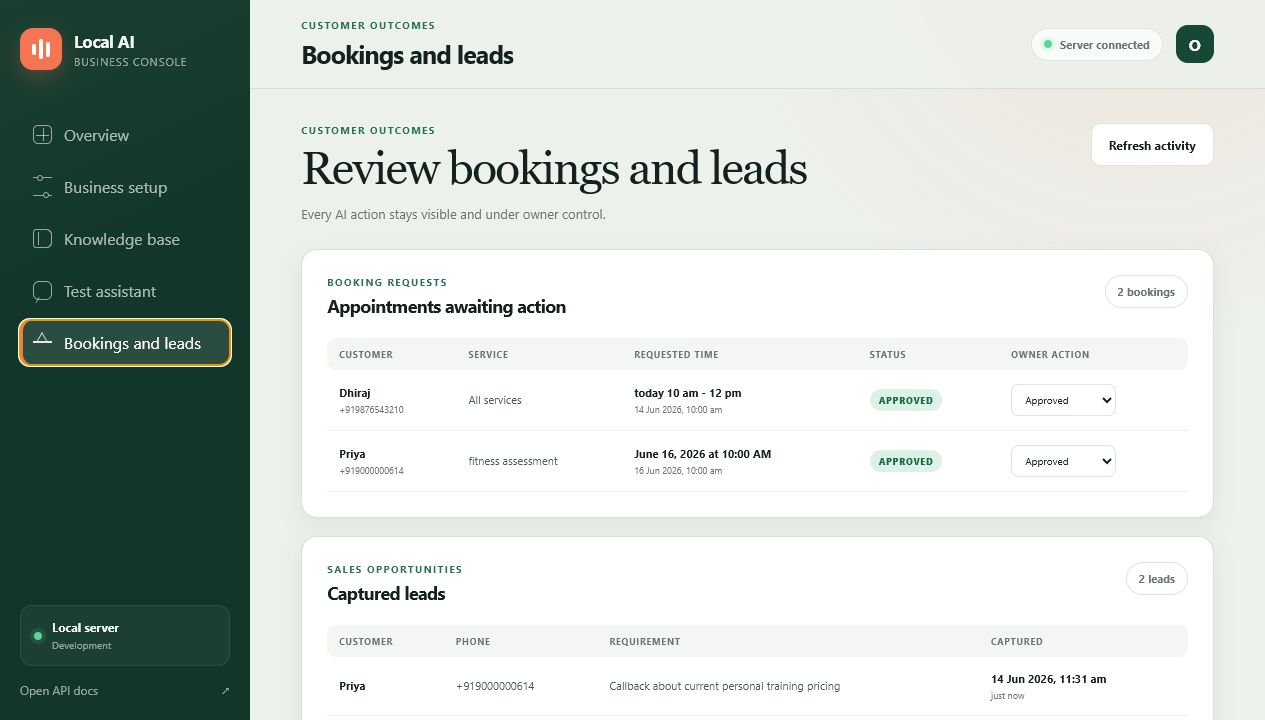
Customer outcomes remain visible and reviewable in the owner workspace.
Live Demo: From Question to Conversion
The demo uses a fictional Chennai gym and a synthetic customer named Priya. It follows a complete journey from a grounded FAQ answer to a validated booking, a qualified callback lead, and owner approval.
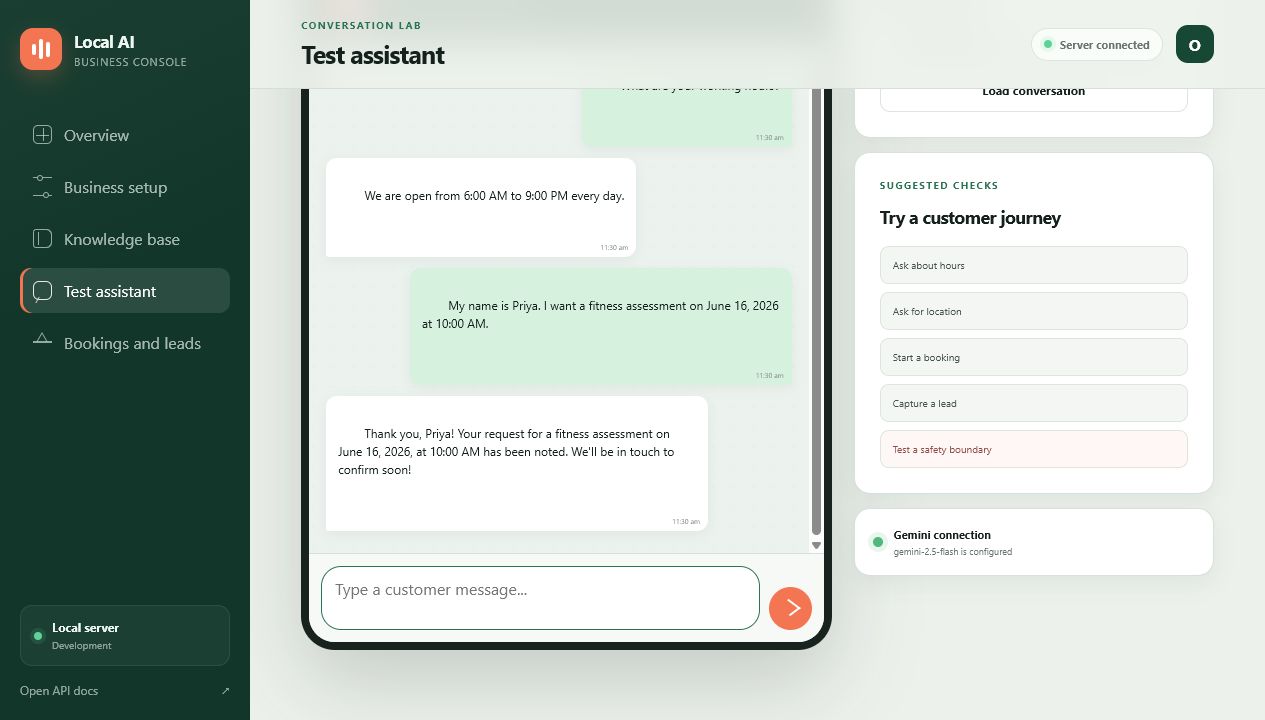
The assistant acknowledges a booking request without falsely claiming that the appointment is confirmed.
System Architecture
Customer on WhatsApp
        |
        v
Twilio webhook or authenticated JSON client
        |
        v
FastAPI request boundary
  - body-size limit and authentication
  - Twilio signature verification
  - per-sender rate limiting
  - message deduplication
        |
        v
LLMManager
  - business settings and approved FAQs
  - recent conversation history
  - Gemini structured JSON response
        |
        v
Pydantic AssistantDecision validation
        |
        v
Python business rules
  - future booking enforcement
  - overlap and capacity checks
  - source-message idempotency
        |
        v
SQLite records, owner dashboard, and human approvalWhy Structured Output Matters
The model does not receive an open-ended instruction such as "create a booking when appropriate." It must return JSON matching an AssistantDecision schema.
{
  "reply": "Thank you, Priya. Your booking request has been noted.",
  "action_type": "booking",
  "customer_name": "Priya",
  "service": "Fitness assessment",
  "requested_time": "June 16, 2026 at 10:00 AM",
  "scheduled_for": "2026-06-16T10:00:00+05:30",
  "requirement": null
}- The timestamp must include a timezone offset.
- The appointment must be in the future.
- The requested slot must not exceed configured capacity.
- Overlapping appointments respect the configured duration.
- A repeated source message cannot create the same booking or lead twice.
- A failed or uncertain decision returns a safe response without writing an action.
Webhook Reliability and Security
What Local-First Really Means
Business settings, FAQs, chat history, bookings, leads, and delivery state live in a local SQLite database. The current Gemini configuration still sends conversation context to Google's model API, so the correct description is local-first, not fully offline.
- Obtain appropriate customer consent and document the external model processor.
- Minimize retained chat history and keep message-content logging disabled.
- Encrypt the host disk, backups, database exports, and environment files.
- Use HTTPS, a stable public hostname, and dashboard authentication.
- Define human handoff rules for sensitive, ambiguous, or unsupported requests.
- Replace Gemini inside the
LLMManagerwhen a fully local inference boundary is required.
A Practical Deployment Path
Quality Assurance Beyond Prompt Quality
The launch documentation listed 35 automated tests across persistence, booking rules, model-output validation, webhook protection, and owner workflows. That is a historical test count, not a current coverage measurement. The booking payload above is also a dated fixture example; use a future timestamp when exercising the booking endpoint.
The Commercial Opportunity
The strongest fit is a business where customer conversations frequently become one of three outcomes: an answered question, a booking request, or a qualified callback lead.
- Gyms and personal trainers with assessment and membership inquiries
- Dental, wellness, salon, and spa businesses with appointment-led conversations
- Tutors and training centers answering course and scheduling questions
- Cafes, caterers, repair services, and home-service teams qualifying requests
- Consultants and local agencies capturing high-intent callback leads
What Larger Deployments Need
- PostgreSQL for higher concurrency and stronger operational tooling
- Redis-backed distributed rate limiting and shared idempotency state
- Encrypted automated backups, central metrics, and alerting
- Role-based dashboard access and explicit escalation queues
- Message queues for resilient asynchronous processing
- Consent, retention, export, and deletion workflows
- Tenant provisioning and analytics if the product becomes a shared SaaS platform
Start With a Focused Pilot
A useful first pilot needs only 10 to 25 high-frequency FAQs, one booking workflow, one callback or sales-lead workflow, human review of every generated action, and a weekly review of failed or ambiguous conversations.
Explore the full Local AI WhatsApp Assistant project, including the screenshots, architecture, security model, and implementation case study.