
Most AI tools ask one model to answer your question. That is fast and cheap, but it also means one model's blind spot can become your blind spot. Mixture of Agents (MoA) changes the pattern: ask several models for independent advice, then let one model combine the strongest parts into a final answer.
The simple way to think about it: a single model is like asking one senior engineer. MoA is like asking a small review panel, then asking the best writer in the room to turn the discussion into one clear response.
In Plain English
- MoA is not a new LLM. It is a way to coordinate several LLMs during one answer.
- Reference models go first. They produce separate answers or critiques.
- The aggregator goes last. It reads the references and writes the final response.
- Hermes exposes MoA as a virtual provider. You can select a MoA preset much like selecting a model.
What the Research Says
The research foundation is the 2024 paper Mixture-of-Agents Enhances Large Language Model Capabilities by Wang et al., later listed on OpenReview as an ICLR 2025 Spotlight. The paper describes a layered setup where multiple LLM agents write responses, later agents read those responses as extra context, and a final aggregator combines them.
One historical result from the 2024 paper: an MoA system using only open-source models scored 65.1% on AlpacaEval 2.0, compared with 57.5% for GPT-4 Omni in the paper's reported comparison. That does not mean MoA wins every task. It means model collaboration can beat a single model on some instruction-following benchmarks.
How Hermes Uses MoA
In the Hermes Agent repository, MoA is implemented as a virtual provider. That means a named MoA preset can appear in the model picker like a model, even though it is really a small workflow behind the scenes. The aggregator is the acting model: it writes the assistant message and can emit tool calls.
Reference models are used as advisers. Hermes fans them out in parallel, collects their responses, and hands them to the aggregator. If the aggregator decides a tool is needed, Hermes continues through its normal agent loop. That is the important part: MoA changes who thinks before the answer, but it still lives inside Hermes.
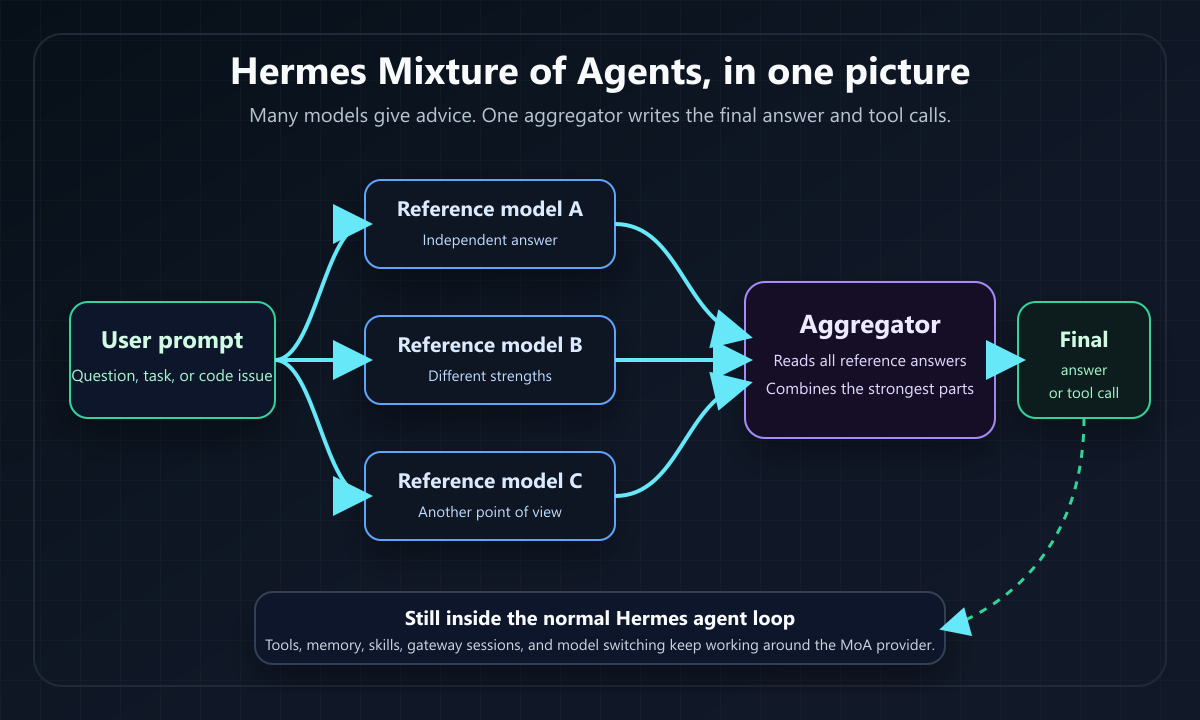
Hermes MoA in one picture: reference models advise, the aggregator writes the final answer, and Hermes keeps the normal agent loop around it.
The Pieces
A Simple Example
Imagine you ask Hermes to review a risky database migration. With a single model, one model reads the task and answers. With MoA, Hermes can ask several models for separate reviews first. One model may focus on schema risk, another on rollback planning, another on test coverage. The aggregator then turns those notes into one practical plan.
Single model:
  User prompt -> One model -> Final answer

Mixture of Agents:
  User prompt -> Reference model A
              -> Reference model B
              -> Reference model C
              -> Aggregator reads A+B+C
              -> Final answer or tool call
Why This Helps
Different models often make different mistakes. One may be better at code, another at long-form reasoning, another at spotting missing assumptions. MoA is useful when those differences matter. It is not magic, but it gives the final answer more raw material than one model would have produced alone.
For Hermes specifically, the interesting bit is that MoA is not isolated from the rest of the agent. It can sit beside the things Hermes already does: provider switching, tools, memory, skills, desktop/dashboard management, and gateway-style usage.
Current Hermes controls and limits
The current Hermes MoA guide distinguishes a named preset from a one-shot request. Use hermes moa configure review to configure a preset and /model review --provider moa to select it. /moa <prompt> uses the default preset for one turn; the argument is the prompt, not a preset name.
Reference fan-out defaults to once per user turn; other cadences can be configured. Reference models advise from conversation text while the aggregator remains responsible for tool calls. Agreeing advisers can share the same mistake, so verify the final proposal against external evidence.
Review which providers receive the conversation. The documented privacy filter is off by default. Display filtering redacts visible references; full filtering also redacts references sent to the aggregator. Neither setting should be assumed to sanitize the original prompt before it is sent to reference providers.
Hermes MoA guide, reviewed September 5, 2026. The paper’s benchmark numbers above describe its historical evaluation, not current model rankings.
When MoA Is Worth It
The trade-off is simple: MoA costs more because it calls more models. If you use three reference models plus one aggregator, you are paying for several model calls instead of one. For small tasks, that is waste. For important decisions, it can be cheap insurance.
A Good Way to Explain It
MoA is not about replacing every single-model workflow. It is about using multiple models when the question deserves more than one point of view. Think of it like code review: you do not need a review panel to rename a file, but you probably want one before changing a production database, designing a new architecture, or trusting an agent with a risky task.
That is why Hermes makes MoA interesting. It brings the review-panel idea into an agent that can still use tools, remember context, switch providers, and continue its normal loop after the aggregator produces the final response.
Putting it into practice
Hermes Agent's MoA mode is best understood as a built-in review panel for an AI agent. It asks multiple models for perspective, then lets an aggregator produce one answer inside the normal Hermes loop. That makes it useful for serious reasoning work, but unnecessary for every prompt.
Sources
- Hermes Agent GitHub repository - primary source for the current MoA virtual-provider implementation notes.
- Hermes Agent provider documentation - official source for provider and model switching behavior.
- Mixture-of-Agents paper on arXiv - primary paper record and benchmark summary.
- ICLR 2025 OpenReview page - confirms the paper's ICLR 2025 Spotlight status and abstract.