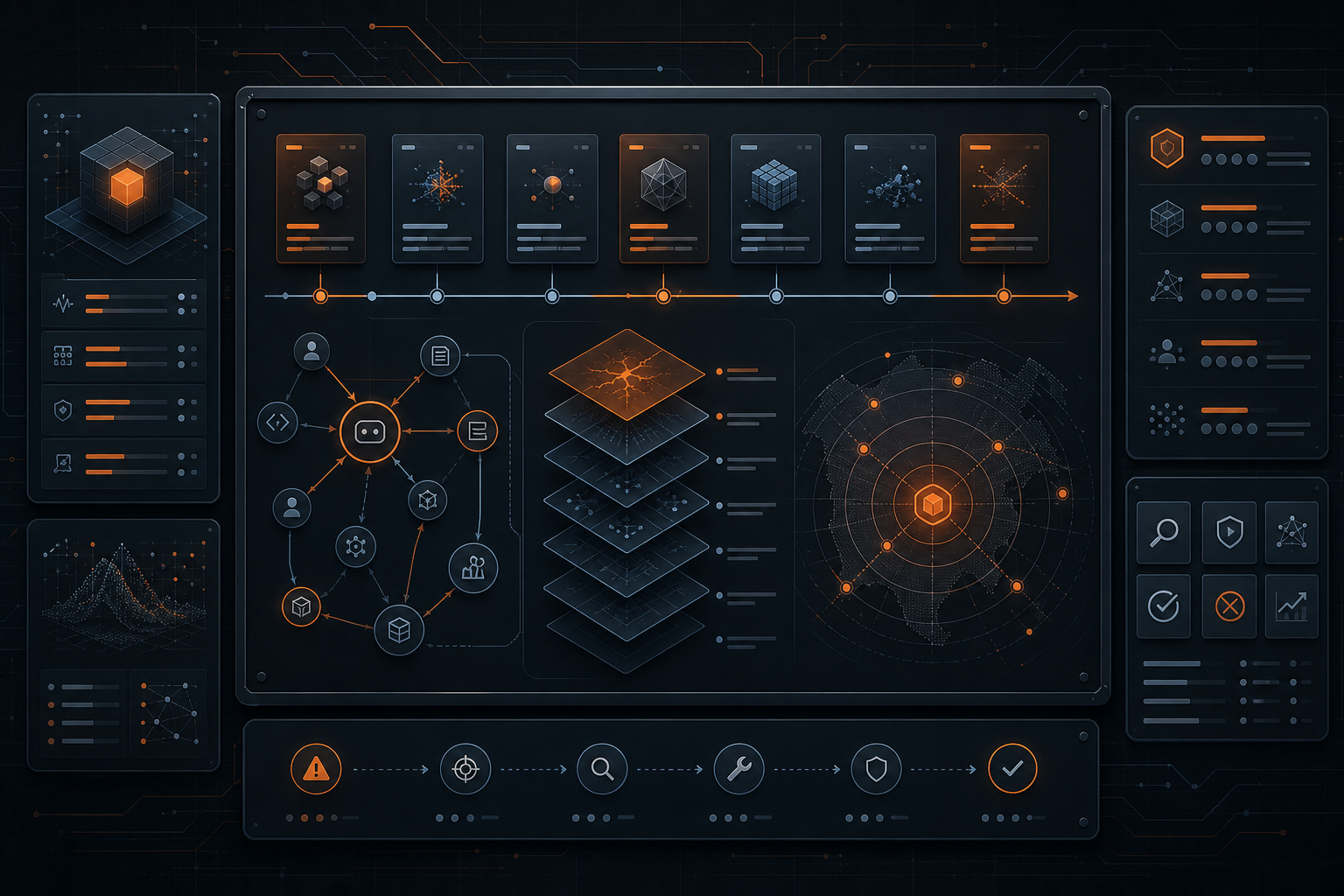
Most AI-agent failures are described badly: “it got confused,” “it hallucinated,” “it ignored the prompt.” Those are symptoms, not postmortems. A useful postmortem turns the run into a timeline, the timeline into a cause, and the cause into a harness improvement.
The point is not to blame the model. The point is to stop paying for the same failure twice.
The template
Use this structure after any serious agent failure or false-success run.
- Goal: what the agent was asked to do.
- Autonomy level: read-only, tool-using, code-editing, external-action, or scheduled.
- Environment: branch, commit, working directory, tool permissions, key dependencies.
- Timeline: prompts, decisions, tool calls, commands, outputs, file changes, approvals.
- Expected outcome: what should have changed.
- Actual outcome: what changed in the real environment.
- Evidence: diffs, logs, screenshots, database queries, test output, generated artifacts.
- Root cause class: model, prompt, tool, environment, policy, verification, or human handoff.
- Blast radius: what could have been affected.
- Redaction: what sensitive material was removed before sharing.
- Prevention: new eval, new guardrail, new fixture, new approval gate, or better report.
Why final summaries are not enough
An agent final message is a witness statement. It is not the evidence. It may be accurate, incomplete, stale, or fabricated. Anthropic’s eval vocabulary separates transcript and outcome for exactly this reason. The transcript records what happened. The outcome proves whether the task succeeded.
For coding agents, the outcome is often executable: tests, typecheck, build, diff, deployed preview. For business agents, the outcome is external state: a ticket, booking, message, or record. The postmortem must inspect that state directly.
A simple failure taxonomy
- Model reasoning failure: wrong plan, wrong assumption, missed constraint.
- Prompt/spec failure: success criteria were ambiguous.
- Tool failure: tool returned bad data, timed out, or hid an error.
- Environment failure: dependencies, credentials, network, branch, test data.
- Policy failure: action should have required approval but did not.
- Verification failure: agent did not run the check or misread output.
- Reporting failure: final answer omitted risk or overstated success.
This taxonomy matters because each class has a different fix. A tool timeout does not need a better prompt. A missing approval gate does not need a smarter model.
Make the postmortem feed the harness
A postmortem is not done until one thing changes. Add a regression eval. Add a required check. Improve redaction. Split a dangerous tool. Make the final report include exit codes. Capture branch state. Whatever the fix is, it must land somewhere durable.
Sources and further reading
- Anthropic, Demystifying evals for AI agents
- LangChain, Agent Evaluation Readiness Checklist
- Dhiraj Das, Agent Blackbox Guide