
Visualizing the core Python data structures.
In automation engineering—whether you’re testing web apps, mobile apps, APIs, or databases—your code must be fast, clean, and predictable. One of the biggest factors influencing that is your choice of data structures.
Choosing the right structure is not academic—it directly impacts:
- How clean your automation code looks
- How fast it executes
- How easy it is to maintain or scale
- How effectively you store or access test data
- How stable and readable your page objects, API utilities, and verifications become
This blog outlines the best Python data structures for automation developers and gives real-world examples for each use case.
1. List – Best for Ordered Collections
Use lists when you have ordered data and need iteration—common in storing multiple web elements, maintaining ordered test steps, parsing API responses, or device lists in mobile automation.
from selenium.webdriver.common.by import By

# Application-specific selectors and expected fixture data.
product_elements = driver.find_elements(By.CSS_SELECTOR, ".product-name")
product_names = [element.text for element in product_elements]
assert "Demo Phone" in product_names
2. Dictionary – Best for Key–Value Mappings
Use dictionaries when data must be accessed by keys, not positions. This is the most commonly used structure in automation frameworks for configs, test data, and cookies.
from selenium.webdriver.common.by import By

headers = {"Content-Type": "application/json"}
locators = {
    "username": (By.ID, "user"),
    "password": (By.ID, "pass"),
    "login_btn": (By.ID, "login"),
}
3. Set – Best for Unique Collections
Use sets when you need unique values, need to find differences or intersections, and order does NOT matter.
# Duplicate checks on synthetic dropdown and API data.
options = ["Small", "Medium", "Large"]
assert len(options) == len(set(options))

records = [{"id": 1}, {"id": 2}]
ids = [item["id"] for item in records]
assert len(ids) == len(set(ids))
4. Tuple – Best for Fixed Values
Use tuples when you want an immutable, fixed-size object. Every Selenium locator is a tuple.
from selenium.webdriver.common.by import By

username = (By.ID, "username")
start_point = (100, 500)
end_point = (300, 500)
5. NamedTuple / Dataclass – Best for Structured Data
When you need structured, readable objects without the heaviness of a class.
from dataclasses import asdict, dataclass

@dataclass
class UserData:
    username: str
    email: str
    role: str

user = UserData("demo", "demo@example.com", "reader")
payload = asdict(user)
assert payload["role"] == "reader"
6. Queue / Deque – Best for High Throughput
For parallel testing, job scheduling, or test orchestration. Deque offers faster pop from left (O(1)) vs list (O(n)).
from collections import deque

def run_device_queue(devices, run_test_on_device):
    queue = deque(devices)
    while queue:
        device = queue.popleft()
        run_test_on_device(device)
7. DefaultDict / Counter – Best for Aggregations
Great for computing API response statistics, log analysis, or error frequency.
from collections import Counter

codes = [resp.status_code for resp in responses]
summary = Counter(codes)

print(summary)
8. Pandas DataFrame – Best for Large Test Data Sets
When dealing with large test data, Excel files, DB dumps, or CSV inputs.
import pandas as pd

def run_login_data(path, verify_login):
    data = pd.read_csv(path, dtype=str, keep_default_na=False)
    for row in data.itertuples(index=False):
        verify_login(row.username, row.password)
🧩 Data Structure Decision Matrix
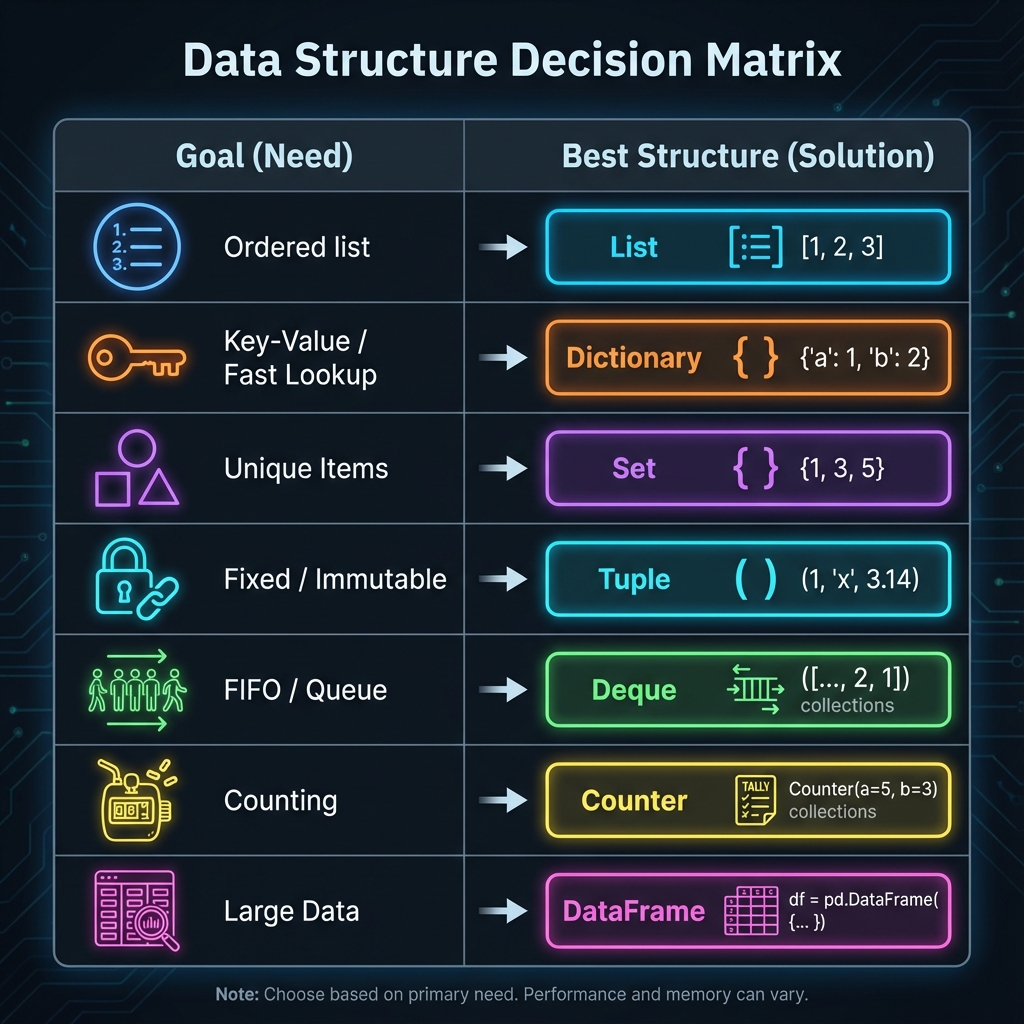
A quick guide to choosing the right data structure.
🎯 Final Thoughts
Efficient automation isn’t only about writing scripts—it’s about writing maintainable, scalable, and high-performance test code. Choosing the right data structure reduces bugs, makes your framework faster, and improves readability.
These snippets demonstrate data structures. Browser, API, and CSV examples need your own fixtures and data. Tuple immutability is shallow: a mutable object inside a tuple can still change. Use dataclasses.asdict for a dataclass mapping, especially when nested records are involved.